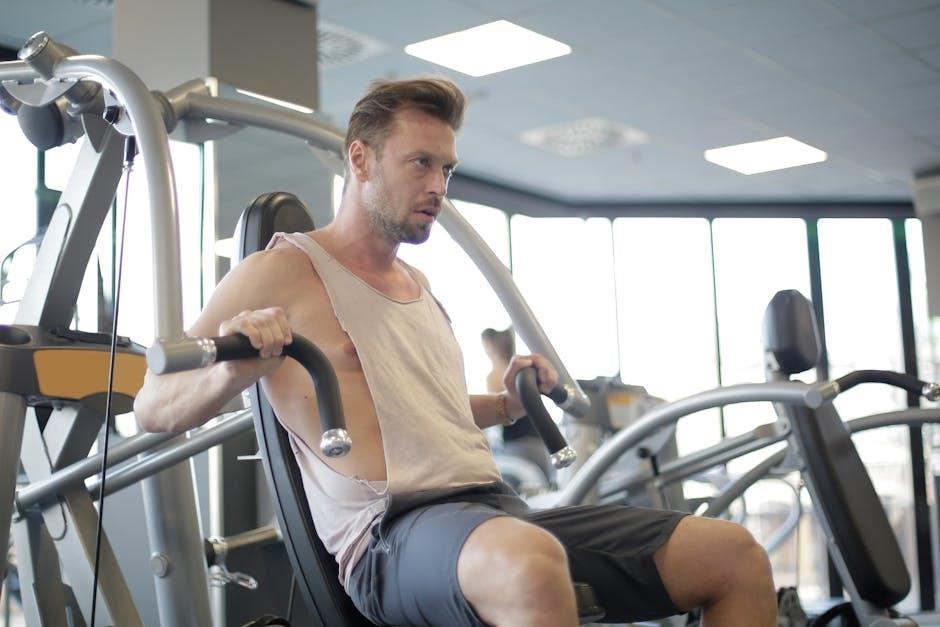
The PPL routine is a highly efficient full-body approach, ideal for those with limited time, enabling rapid muscle group rotation and optimized recovery periods.
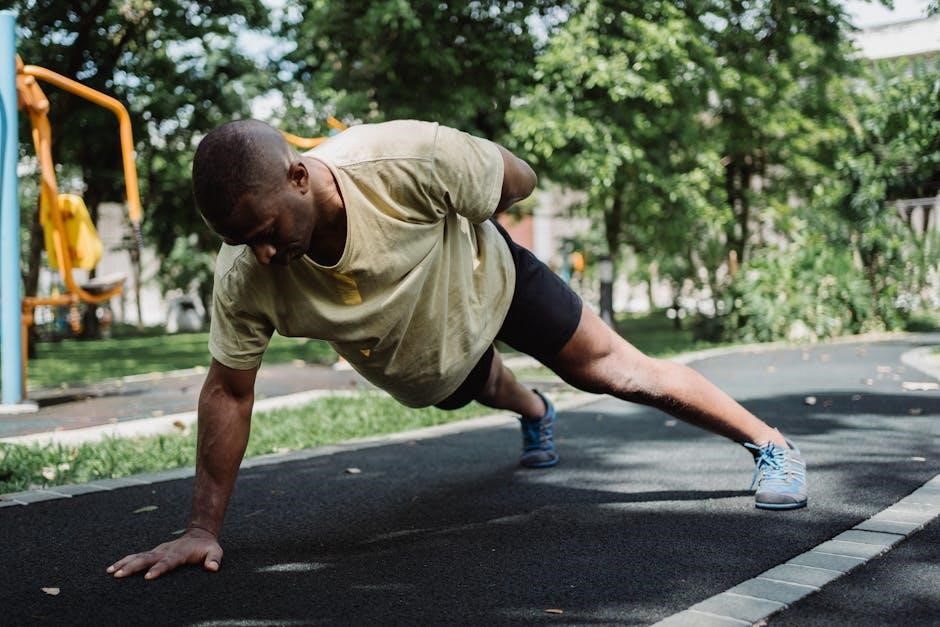
Effective training avoids overworking muscles, allowing sufficient recovery – a key principle addressed by PPL splits for consistent gains and improved fitness levels.
Dedicated planning, rather than random workouts, is crucial for success, ensuring focused effort towards clearly defined goals, whether strength, size, or overall well-being.
What is a Push Pull Legs Split?
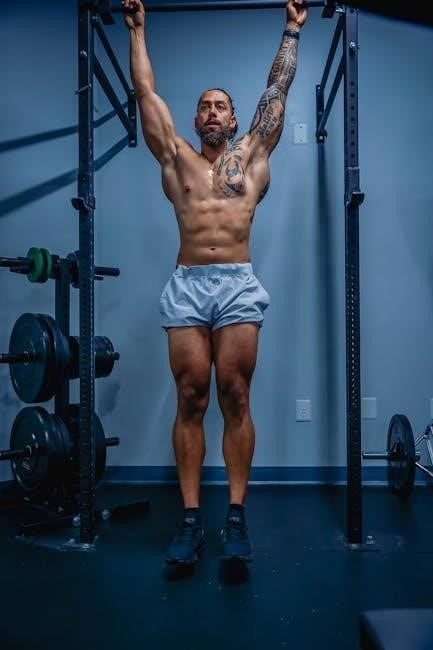
A Push Pull Legs (PPL) split is a strength training methodology that divides workouts based on movement patterns rather than muscle groups. “Push” days focus on exercises that involve pushing weight away from the body – think chest, shoulders, and triceps. “Pull” days concentrate on pulling movements, targeting the back, biceps, and forearms.
Leg days, as the name suggests, are dedicated to lower body exercises, working the quads, hamstrings, and calves. This structured approach allows for focused muscle stimulation and adequate recovery time for each group. The 5-day PPL routine typically involves performing each of these workouts once per week, with rest days strategically placed for optimal results.
This split is favored for its efficiency and ability to promote balanced muscle development, preventing overtraining and maximizing gains.
Benefits of a PPL Routine
The primary benefit of a PPL routine lies in its ability to optimize recovery. By grouping muscles based on movement patterns, you allow specific muscle groups ample time to rest and rebuild before being worked again. This minimizes the risk of overtraining, a major impediment to muscle growth.
Furthermore, a PPL split promotes balanced muscle development. Each muscle group receives dedicated attention, ensuring a proportionate physique. The routine’s structure also lends itself well to progressive overload – gradually increasing weight or reps – which is crucial for continuous gains.
For those with busy schedules, the PPL split offers an efficient way to train the entire body effectively in just a few workouts per week.
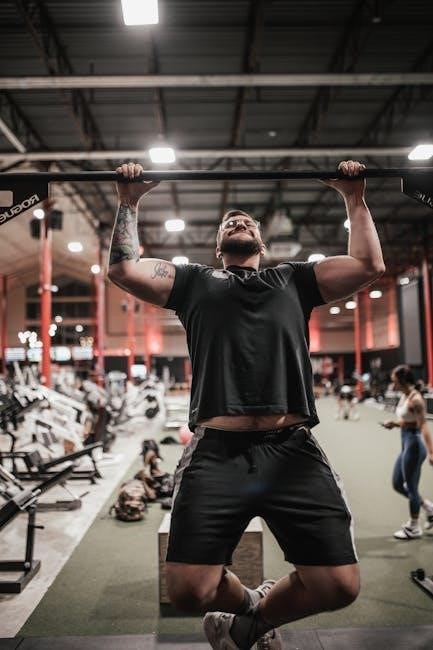
Understanding the Workout Structure
The PPL structure divides training into three core sessions: Push (chest, shoulders, triceps), Pull (back, biceps, forearms), and Legs (quads, hamstrings, calves).
Push Day: Muscle Groups Targeted
Push day focuses on all muscles involved in pushing movements, primarily targeting the chest, shoulders, and triceps. Chest exercises build pectoral strength and size, while shoulder work develops overall upper body power and stability.
Triceps, crucial for extending the arm, receive direct attention, complementing chest and shoulder development. This grouping allows for synergistic muscle activation, maximizing efficiency and promoting balanced upper body growth. Effective push day routines prioritize compound movements like bench presses and overhead presses, supplemented by isolation exercises for targeted muscle development.
Proper form and controlled movements are essential to prevent injury and ensure optimal muscle engagement during each exercise. Remember, a well-structured push day lays the foundation for a strong and balanced physique.
Pull Day: Muscle Groups Targeted
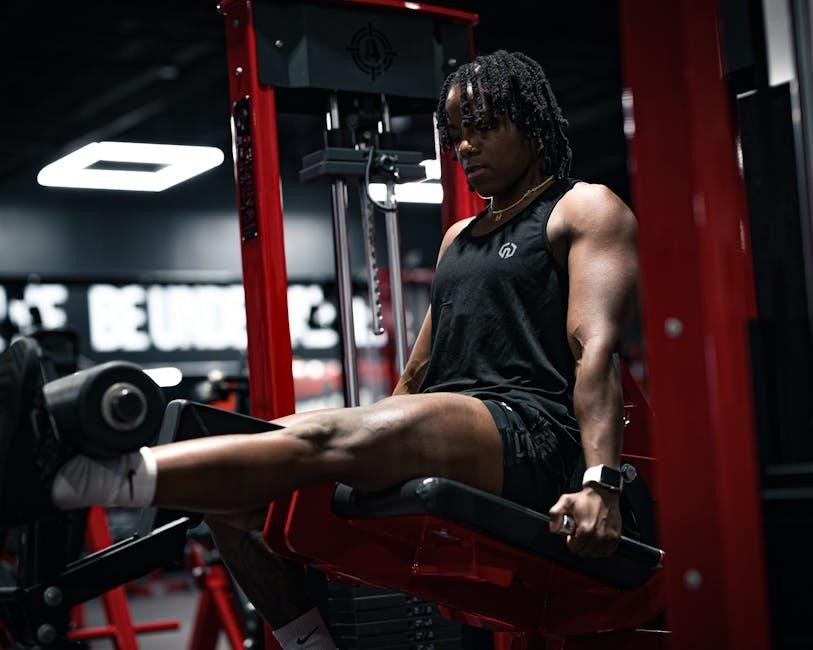
Pull day concentrates on muscles used in pulling motions, primarily the back, biceps, and forearms; Back exercises build strength and width, contributing to a powerful and defined physique. Biceps work enhances arm flexion strength, complementing back development for balanced upper body musculature.
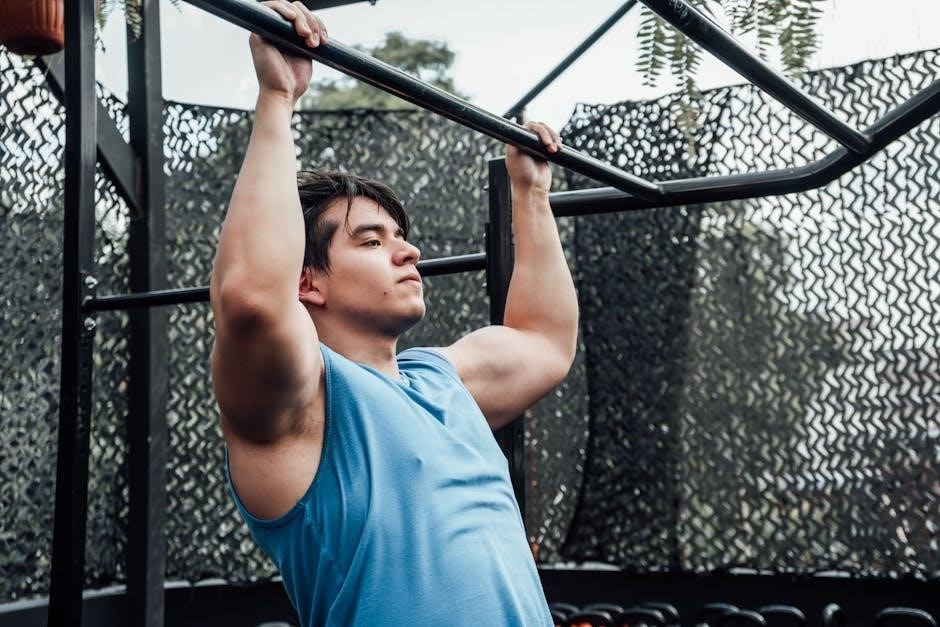
Forearms, often overlooked, receive direct attention, improving grip strength and overall pulling power. This grouping allows for synergistic muscle activation, maximizing efficiency and promoting balanced upper body growth. Compound movements like pull-ups and rows are foundational, supplemented by isolation exercises for targeted muscle development.
Prioritizing proper form is crucial to prevent injury and ensure optimal muscle engagement during each exercise on pull day.
Leg Day: Muscle Groups Targeted
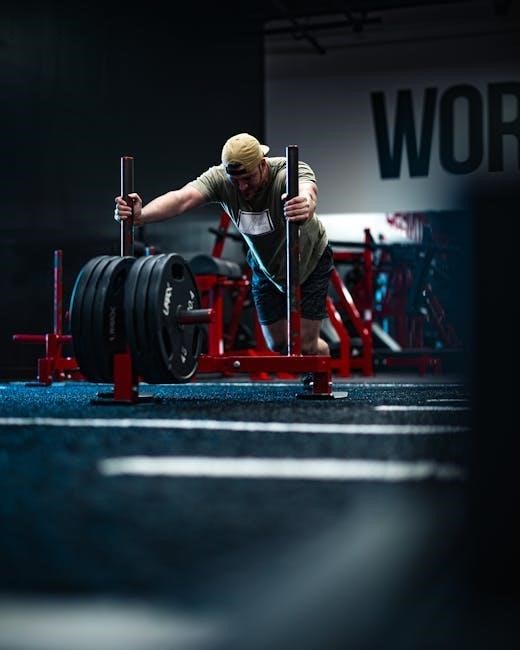
Leg day focuses on the major muscle groups of the lower body: quadriceps, hamstrings, and calves. Quadriceps exercises, like squats and lunges, build strength and size in the front of the thighs, crucial for power and stability.
Hamstring work, often paired with quad exercises, balances leg development and improves posterior chain strength. Calf exercises target the gastrocnemius and soleus, enhancing lower leg definition and athletic performance. A comprehensive leg day routine incorporates both compound and isolation movements.
Effective leg training is fundamental for overall strength, athleticism, and metabolic function, contributing significantly to a well-rounded physique.
Detailed 5-Day PPL Workout Routine
This routine strategically divides workouts, targeting specific muscle groups each day, allowing for focused effort and optimal recovery between sessions for maximum gains.
Day 1: Push – Chest, Shoulders, Triceps
Begin your PPL journey with a focus on pushing movements, effectively targeting the chest, shoulders, and triceps. This day establishes a strong foundation for upper body strength and development.
Chest Exercises
Incorporate bench presses (flat, incline, decline) for overall chest mass, dumbbell flyes for chest width, and cable crossovers to refine chest definition. Aim for 3-4 sets of 8-12 repetitions for each exercise.
Shoulder Exercises
Prioritize overhead presses (barbell or dumbbell) for shoulder strength, lateral raises for shoulder width, and front raises to target the anterior deltoids. Perform 3-4 sets of 10-15 repetitions.
Triceps Exercises
Complete the push day with triceps extensions (overhead, lying, or cable) and close-grip bench presses. These exercises isolate and strengthen the triceps, contributing to arm size and definition. Execute 3-4 sets of 12-15 repetitions.
Chest day forms the cornerstone of the ‘push’ workout, demanding a variety of exercises to stimulate all areas of the pectoral muscles. Begin with compound movements like barbell bench presses, focusing on controlled descent and explosive ascent.
Incorporate incline dumbbell presses to target the upper chest, adding fullness and definition; Decline presses effectively work the lower chest, creating a well-rounded physique. Don’t neglect isolation exercises; dumbbell flyes stretch and contract the chest, enhancing muscle fiber recruitment.
Cable crossovers provide constant tension throughout the range of motion, refining chest shape. Aim for 3-4 sets of 8-12 repetitions per exercise, prioritizing proper form over sheer weight.
Shoulder training requires a balanced approach to develop all three deltoid heads – anterior, medial, and posterior. Start with overhead presses, utilizing either a barbell or dumbbells, to build overall shoulder strength and mass.
Lateral raises are crucial for widening the shoulders, emphasizing the medial deltoid. Front raises target the anterior deltoid, contributing to shoulder definition. Rear delt flyes, performed with dumbbells or on a machine, are essential for balanced shoulder development and posture.
Face pulls improve shoulder health and strengthen the rear deltoids. Perform 3-4 sets of 10-15 repetitions for each exercise, maintaining strict form to prevent injury and maximize muscle activation.
Triceps development is vital for well-rounded arm aesthetics and pushing strength. Close-grip bench presses effectively target the triceps while still engaging the chest. Skullcrushers, performed with a barbell or dumbbells, isolate the triceps for maximum growth, but require careful form.
Overhead triceps extensions, using a dumbbell or cable, provide a different angle of attack, hitting the long head of the triceps. Cable pushdowns are a versatile exercise, allowing for various attachments to target different triceps fibers.
Aim for 3-4 sets of 10-12 repetitions for each exercise, focusing on controlled movements and a full range of motion to maximize muscle fiber recruitment and prevent injury.
Day 2: Pull – Back, Biceps, Forearms
Pull day focuses on the posterior chain, building a strong and balanced physique. Back exercises are paramount, starting with pull-ups or lat pulldowns to develop width. Barbell rows and seated cable rows build thickness and overall back strength.
Biceps work complements the back, enhancing arm aesthetics. Barbell curls and dumbbell curls are foundational exercises, while hammer curls target the brachialis for increased arm size. Forearm exercises, often neglected, improve grip strength.
Include wrist curls and reverse wrist curls to strengthen forearm flexors and extensors. Prioritize proper form and controlled movements throughout the workout for optimal results and injury prevention;
Back Exercises
Back training should prioritize both width and thickness for a well-developed physique. Begin with compound movements like pull-ups, aiming for as many reps as possible, or lat pulldowns as a scalable alternative. These exercises effectively target the lats, contributing to a wider back.
Barbell rows are crucial for building back thickness and overall strength. Maintain a flat back and controlled movement throughout each rep. Seated cable rows offer a different angle of attack, further stimulating muscle growth.
Face pulls are excellent for improving posture and strengthening the rear deltoids, contributing to shoulder health. Incorporate these to balance out pushing movements from previous workouts.
Biceps Exercises
Biceps training should focus on both peak and overall mass. Start with heavier compound lifts like barbell curls to build a solid foundation of strength and size. Controlled form is paramount to prevent injury and maximize muscle activation.
Dumbbell curls allow for a greater range of motion and can help address any muscle imbalances. Alternate between hammer curls, focusing on the brachialis, and standard curls for complete development.
Concentration curls provide excellent isolation, ensuring maximum contraction and a strong mind-muscle connection. Finish with cable curls for constant tension throughout the entire range of motion, promoting further growth.
Forearm Exercises
Forearm development is often overlooked, yet crucial for grip strength and overall arm aesthetics. Begin with wrist curls, both palm-up and palm-down, to target the flexors and extensors respectively. Utilize a moderate weight and focus on controlled movements.
Reverse curls are excellent for building forearm mass and improving grip. They also indirectly work the biceps, providing a synergistic benefit. Maintain a firm grip throughout the exercise.
Farmer’s walks are a fantastic functional exercise that builds incredible grip strength and endurance. Hold heavy dumbbells or kettlebells and walk for a designated distance or time.
Day 3: Legs – Quads, Hamstrings, Calves
Leg day demands a comprehensive approach targeting all major muscle groups. Prioritize compound movements like squats – back squats, front squats, or goblet squats – to maximize muscle activation and strength gains. Focus on proper form to prevent injuries.
Lunges (walking, reverse, or stationary) are excellent for unilateral leg strength and balance. Incorporate hamstring curls and Romanian deadlifts to effectively target the posterior chain.
Calf raises (standing or seated) are essential for developing well-rounded legs. Vary the rep ranges and tempos to stimulate different muscle fibers. Remember consistent effort yields results!
Quadriceps Exercises
Prioritize compound lifts like back squats, aiming for 3-4 sets of 6-12 repetitions. Front squats offer a different stimulus, emphasizing the quads even further; perform 3 sets of 8-15 reps.
Leg presses provide a controlled environment for heavy loading, allowing for 4 sets of 10-15 repetitions. Incorporate leg extensions to isolate the quads, completing 3-4 sets of 12-20 reps.
Bulgarian split squats are excellent for unilateral strength and balance, performing 3 sets of 10-15 reps per leg. Remember to maintain proper form throughout each exercise to maximize effectiveness and minimize injury risk.
Hamstring Exercises
Romanian deadlifts (RDLs) are foundational, targeting the hamstrings and glutes; execute 3-4 sets of 8-12 repetitions. Lying leg curls provide isolation, allowing for 3-4 sets of 12-15 reps with controlled movements.
Good mornings are a challenging exercise requiring proper form – perform 3 sets of 10-15 reps, focusing on a slight bend in the knees. Seated leg curls offer another isolation option, completing 3 sets of 15-20 repetitions.
Glute-ham raises are advanced but highly effective; aim for 3 sets to failure. Prioritize controlled eccentric contractions to maximize hamstring engagement and promote muscle growth.
Calf Exercises
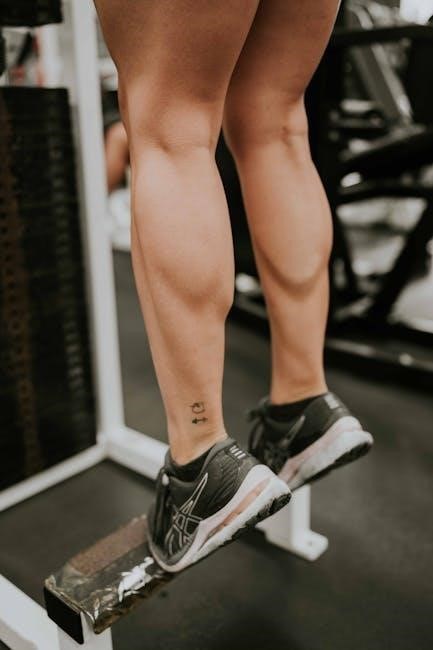
Standing calf raises are a staple, targeting the gastrocnemius; perform 4 sets of 15-20 repetitions, ensuring a full range of motion. Seated calf raises isolate the soleus muscle, requiring 4 sets of 20-25 reps with a slower tempo.
Leg press calf raises offer a variation, allowing for heavier loads – complete 3-4 sets of 12-15 repetitions. Single-leg calf raises increase intensity and address imbalances, performing 3 sets of 15-20 reps per leg.
Donkey calf raises, though less common, provide a unique stimulus; aim for 3 sets to failure. Focus on controlled movements and a peak contraction at the top of each repetition for optimal calf development.
Day 4: Rest or Active Recovery
Prioritizing recovery is paramount within the 5-day PPL split; Day 4 serves as a crucial opportunity for muscle repair and replenishment. Complete rest is beneficial, allowing the body to fully recover from the previous three intense workout days.
Active recovery, however, can enhance blood flow and reduce muscle soreness. Light activities like walking, swimming, or cycling at a low intensity are excellent choices.
Foam rolling and stretching can also aid recovery, improving flexibility and reducing muscle tension. Avoid strenuous exercise on this day to prevent overtraining and maximize the benefits of the PPL routine. Listen to your body and choose the recovery method that best suits your needs.
Day 5: Push – Variation & Focus
Day 5 revisits the “Push” muscle groups – chest, shoulders, and triceps – but with a focus on variations to stimulate new muscle growth and prevent plateaus. This isn’t simply repeating Day 1; it’s about refining and challenging the muscles differently.
Incline exercises target the upper chest, while lateral shoulder work emphasizes the medial deltoid. Overhead triceps extensions provide a different stimulus compared to earlier triceps exercises.
Strategic variation ensures comprehensive development and prevents adaptation. Maintaining a well-structured plan, as emphasized for successful workouts, is key to maximizing results. This final push day completes the cycle before the routine restarts.
Incline Chest Exercises
Incline dumbbell press is a cornerstone, targeting the upper pectoral muscles for a fuller chest development. Adjusting the incline angle shifts the emphasis, promoting balanced muscle growth. Aim for 3-4 sets of 8-12 repetitions, focusing on controlled movements.
Incline barbell press offers a heavier loading option, suitable for those seeking strength gains. Proper form is crucial to avoid shoulder impingement; consider a spotter for heavier sets. Maintain a similar rep range as the dumbbell variation.
Cable flyes on an incline bench provide constant tension throughout the movement, enhancing muscle activation. This variation complements the pressing exercises, completing a comprehensive chest workout.
Lateral Shoulder Exercises
Dumbbell lateral raises are fundamental for building wider shoulders, focusing on the medial deltoid. Maintain a slight bend in your elbows and lift the dumbbells to shoulder height, controlling the descent. Perform 3-4 sets of 12-15 repetitions.
Cable lateral raises provide constant tension throughout the range of motion, enhancing muscle engagement. This variation minimizes momentum, forcing the deltoids to work harder. Adjust the cable height for optimal positioning.
Face pulls are excellent for improving shoulder health and posture, targeting the rear deltoids and rotator cuff muscles. Use a rope attachment and pull towards your face, squeezing your shoulder blades together. Include 3 sets of 15-20 reps.
Overhead Triceps Extensions
Dumbbell overhead extensions effectively isolate the triceps, promoting muscle growth and definition. Use one or two dumbbells, keeping your elbows close to your head throughout the movement. Perform 3-4 sets of 10-12 repetitions, focusing on a controlled descent.
Cable overhead extensions offer consistent tension, maximizing triceps activation. Utilize a rope or straight bar attachment, maintaining a stable core and proper form. This variation allows for a greater range of motion.
EZ-bar skullcrushers are a challenging exercise targeting all three heads of the triceps. Lie on a bench and lower the EZ-bar towards your forehead, keeping your upper arms stationary. Complete 3 sets of 8-10 reps.

Important Considerations for Success
Consistent progress relies on proper warm-ups, strategic overload, and adequate nutrition for recovery; planning is key to achieving optimal results and avoiding plateaus.
Warm-up and Cool-down
Prioritizing warm-ups is non-negotiable before each PPL session, preparing muscles and joints for the demands ahead, significantly reducing injury risk and enhancing performance.
Dynamic stretching, like arm circles and leg swings, increases blood flow and range of motion, while light cardio elevates your heart rate, priming your body for exertion.
Cool-downs are equally vital, gradually lowering your heart rate and preventing muscle soreness; static stretching, holding each stretch for 20-30 seconds, improves flexibility.
Effective cool-downs aid in muscle recovery by removing metabolic waste products, promoting relaxation, and preparing your body for the next workout session, ensuring sustained progress.
Don’t skip these steps; they are integral to maximizing benefits and minimizing potential setbacks in your 5-day PPL routine, fostering long-term fitness success.
Progressive Overload
Progressive overload is the cornerstone of muscle growth and strength gains in any training program, including the 5-day PPL routine; it’s about consistently challenging your muscles.
Gradually increase the weight, repetitions, or sets over time, forcing your muscles to adapt and become stronger; avoid plateaus by continually pushing your limits safely.
Small, incremental increases are preferable to large jumps, minimizing injury risk and ensuring sustainable progress; track your workouts to monitor improvements accurately.
Consider variations like reducing rest times or increasing training frequency as alternative methods of progressive overload, adding complexity and stimulating further adaptation.
Consistent application of this principle is crucial for long-term success, ensuring your body continues to respond and evolve, maximizing the effectiveness of your PPL routine.
Nutrition and Recovery
Optimal nutrition is paramount alongside the 5-day PPL routine, providing the building blocks for muscle repair and growth; prioritize protein intake to support muscle protein synthesis.
Consume adequate calories to fuel your workouts and recovery, ensuring a slight caloric surplus if your goal is muscle gain; focus on whole, unprocessed foods for sustained energy.
Prioritize sleep – aim for 7-9 hours of quality sleep per night – as this is when the majority of muscle recovery and growth occurs; establish a consistent sleep schedule.
Active recovery, like light cardio or stretching, can enhance blood flow and reduce muscle soreness; incorporate rest days into your routine to prevent overtraining.
Hydration is also key; drink plenty of water throughout the day to support optimal bodily functions and enhance performance, maximizing the benefits of your PPL program.